
Free tool · Cost of operating a truck
LFS Cost Per Mile Calculator.
Before you book a load, dispatch a truck or price a lane, you need to know one number: what it costs that carrier to run every mile. Logistical Forwarding Solutions built a free trucking cost per mile calculator for exactly that, and I want every Freight University student to use it.

Why it matters
Cost per mile is the floor under every rate.
Everything I teach comes back to keeping the carrier alive. A trucking company doesn't close because of one bad load. It closes because it took load after load without knowing whether those loads covered the cost of running the truck.
Cost per mile is everything it costs to run the truck for a year, divided by every mile it ran, loaded and empty. Any rate below it loses money. That's why a dispatcher or a broker who serves carriers should know a carrier's cost per mile before booking. That's how you keep the carrier alive, thriving and growing instead of hauling itself out of business one cheap load at a time.
The calculator
What the LFS cost per mile calculator shows you
Put in your miles, payments, fuel, driver pay and bills. It works for one truck, or a whole fleet truck by truck, and takes about 15 minutes with your records in front of you.
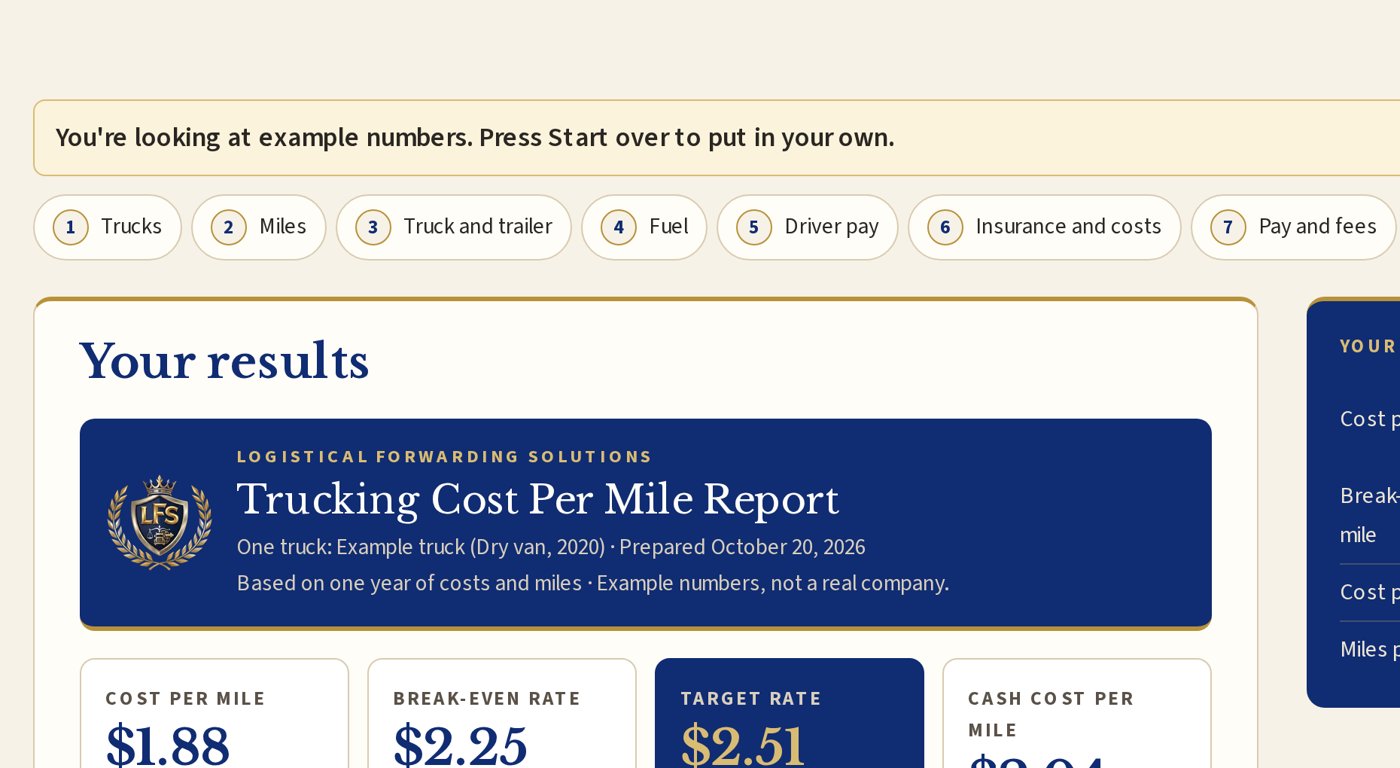
A year of costs divided by a year of miles, loaded and empty.
The least a load can pay per loaded mile without losing money, after your percentage fees.
The rate per loaded mile that covers every cost and leaves the profit you set.
The same math using the payments that leave your bank account instead of truck wear.
Fuel, tires, repairs, tolls and per-mile pay.
Truck payment, insurance, permits and office bills. That's why a slow week costs so much.
How to use it
Five steps to your owner-operator cost per mile
- 1 · Tell it about your trucksOne truck at a time is the most accurate. The whole fleet at once is quicker.
- 2 · Enter your miles and daysTotal miles in a year, the miles you were paid for, the days the truck works and the loads you haul.
- 3 · Enter what the truck costs youPayments, wear on the equipment, fuel, driver pay (yours too), insurance, repairs, tolls, permits and office bills.
- 4 · Enter load pay and feesWhat your loads pay per loaded mile, any factoring or dispatch percentage, and the profit you want.
- 5 · Read your numbers and check a loadA report you can print or save that shows the math with your numbers and checks whether an offered load covers your costs.
The math
Plain arithmetic, the way I teach it
The calculator doesn't guess for you. Cost per mile is a year of costs divided by a year of miles, loaded and empty. The break-even rate per loaded mile divides your costs by what's left after percentage fees, subtracts other pay like detention, and spreads the rest over your loaded miles. Truck wear is what the truck is worth today, minus what it will be worth when you replace it, divided by the years you'll run it.
Here's the made-up example LFS uses, not a benchmark: a truck that costs $200,000 a year to run and drives 100,000 miles costs $2.00 per mile. If only 80,000 of those miles are paid, each paid mile has to bring in $2.50 just to break even, before fees and profit. That's why empty miles matter so much. And fees are divided out, not added on: with a 10% fee, $2.00 becomes $2.22, not $2.20.
For the step-by-step guide, read How to figure your trucking cost per mile and breakeven rate on the LFS site.
The PLSP mindset
Know the carrier's number before you book.
A Professional Logistics Service Provider doesn't just move freight. You protect the carrier behind it. Whether you're a dispatcher, a freight broker or someone who builds trucking companies, the cost per mile is where every good decision starts. The free training teaches the rest.
About the PLSP certificationFrom the same team
LFS AOS and MT
The calculator comes from Logistical Forwarding Solutions, the company behind Freight University. LFS also builds LFS AOS, AI software for trucking companies, dispatchers and brokers, with MT, its AI coworker. A load is never booked without your approval. LFS AOS is invite-only. Learn about LFS AOS.
FAQ
Questions, answered.
How do you calculate trucking cost per mile?
Add up everything it costs to run the truck for a year, then divide by every mile it drove that year, loaded and empty. The free LFS calculator does it for one truck or a whole fleet.
What is a break-even rate per mile?
The least a load can pay per loaded mile without losing money. It's higher than your cost per mile because paid miles have to cover empty miles and percentage fees.
Why should dispatchers and brokers know a carrier's cost per mile?
Because booking a load below a carrier's cost per mile moves the carrier backward. Knowing the number is how you help the carrier stay alive and grow.
Is the information I enter saved or sent anywhere?
According to LFS, the calculator runs in your browser and nothing you type is sent to them or anyone else. Your numbers stay in that browser on that device until you press Start over.
Ready when you are