
FU·008 · Book · 37 pages
Why Your Logistics Business Must Be Found Online
Build reputation and trust that help shippers and carriers find you through search and AI.
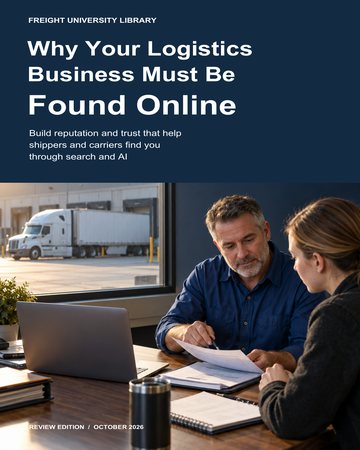
Your skills haven't disappeared. The evidence of those skills is missing where the buyer is looking.
About the book
What it's about
In brief: A practical guide to getting your logistics services found and trusted through search, AI-assisted discovery, useful content, and real relationships. Ten chapters, each with a scenario, an exercise with a suggested answer and key takeaways, plus six worksheets and a 30-day plan. Review edition: generated photographic cover and ten chapter-image briefs; chapter photographs are not included.
Your next shipper or carrier may hear about you through a referral, search for your services, or ask an AI tool for help. This practical Freight University short book shows you how to give them accurate information and a clear reason to contact you. Ten chapters cover service-based personal branding, choosing a niche, calm professional presentation, building a useful website, search and AI visibility, shipper conversations, carrier relationships, reputation, and measured investment in yourself. Each chapter includes a scenario, an exercise with a suggested answer, key takeaways, and related reading. Six worksheets and a 30-day plan help you put the teaching to work. Search still matters; AI recommendations are another discovery route, not a guarantee of vetting, rankings, or business. This 37-page review edition includes a generated photographic cover and ten chapter-image briefs; completed chapter photographs are not included.
Search still matters. An AI mention is not proof that a provider has been vetted, and the book makes no promise of rankings, recommendations or revenue. Scenarios are fictional teaching examples, and dollar figures in the exercises are hypothetical planning assumptions. Statistics from early research that could not be verified are listed as excluded in the sources section and are not taught as fact.
What you'll learn
Five things to take away
- Explain your actual logistics role and the services you can support.
- Choose an equipment, geographic, or customer focus that fits your capabilities.
- Help shippers and carriers understand and check your business online.
- Use search and AI-assisted discovery without promises of guaranteed recommendations.
- Build a reputation with evidence and test marketing spending against real conversations.
Inside
Chapter highlights
Follow a shipper or carrier from first question to first contact, and fix the blank walls.
Write a service statement with boundaries and test your focus against real operations.
Let your process carry the confidence; an honest, short introduction someone can understand.
The minimum useful pages, contact that works from a phone, and a consistent identity.
What the evidence supports about search and AI, answering specific questions, testing honestly.
Explain the work before claiming the result, and open a useful first conversation.
Clear load and payment information that makes a carrier want to work with you again.
Replace unsupported claims with evidence a customer can check.
Set a spending limit, a measurement and a review date; a hypothetical $600 test, worked out.
A 30-day plan and a weekly routine you can actually keep.
Built into Freight University
Keep the carrier alive and growing.
Freight University teaches the Professional Logistics Service Provider as someone who serves first. Being found online is the same discipline: say plainly what you do, show evidence someone can check, and let dependable service carry the reputation. PLSP here describes a service-minded approach and the Freight University learning path, not a government credential.
See the free trainingKeep reading
More from the library



FAQ
Questions about this book
Does this book say Google or search is obsolete?
No. It teaches search fundamentals alongside growing AI-assisted discovery, referrals, and direct relationships. An AI mention is not proof that a provider has been vetted.
Who is this book for?
Freight brokers and agents, dispatchers, carrier owners, and other logistics professionals who want to explain their services clearly and become easier to find and trust.
What practical material is included?
Ten chapters with scenarios, exercises and suggested answers, key takeaways, six worksheets, a 30-day plan, source notes, a generated photographic cover, and ten chapter-image briefs.
Does it promise rankings, AI recommendations, or customer revenue?
No. Marketing outcomes vary. The spending and performance calculations are labeled hypothetical exercises, not forecasts or vendor prices.
Is this a fully illustrated final edition?
This is the 37-page review edition authorized for the Library. It includes the cover and chapter-image briefs. Chapter photographs have not been generated.
Ready when you are