
FU·009 · Book · 114 pages
Onboarding a Carrier — Green Light or Red Flag?
A Beginner’s Guide to Verifying Carriers, Understanding CSA Records, and Investigating Drivers.
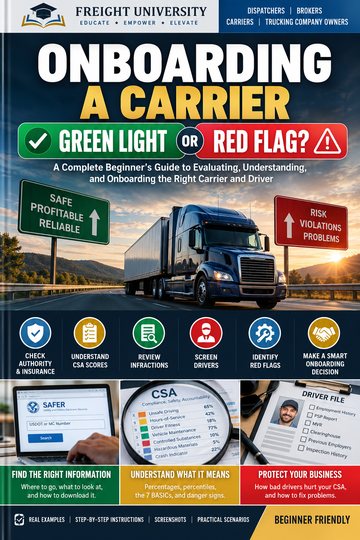
Active authority starts the review. It doesn't finish it.
About the book
What it's about
In brief: A beginner’s guide to deciding whether a trucking company is ready to haul a load. Learn to verify operating authority and insurance, understand all seven CSA BASICs, download FMCSA inspection and violation histories, recognize serious patterns, and check driver history through the proper channels. Includes fictional cases, worksheets, corrective actions, and the role of MT and LFS AOS.
A carrier might have active operating authority and insurance while its roadside inspection history tells a different story. A driver might have a valid license while the hiring carrier still lacks the required safety and employment checks. This book shows you where to look, what you can legally access, what the records mean, and what you must verify before accepting a load or hiring a driver.
Twelve chapters, each with three short lessons and a field lab, walk a beginner through identifying the real carrier, SAFER, Licensing & Insurance and SMS, all seven CSA BASICs, percentages versus percentiles, downloading inspection and violation data, reading patterns without inventing causes, driver history through MVR, PSP and the Clearinghouse, FMCSA interventions, DataQs, and broker and carrier capstones. Every case, company and driver in the book is fictional. Green Light, Hold & Verify and Stop are Freight University teaching labels, not FMCSA ratings. MT and LFS AOS exercises are demonstrations; automated SMS analysis and continuous CSA monitoring are described as proposed, not live. This is a 114-page review edition with 20 original diagrams; recheck official sources before operational use.
What you'll learn
Five things to take away
- Verify the real carrier and its operating authority, insurance and identity.
- Open FMCSA SAFER and SMS and download available public inspection and violation histories.
- Understand all seven BASICs, separate percentiles from percentages, and recognize repeated red flags.
- Investigate drivers through permitted employment, PSP, MVR, Clearinghouse and DQF channels.
- Document Green Light, Hold & Verify, or Red Flag / Stop decisions without pretending those are FMCSA ratings.
- Improve a carrier's safety practices and challenge incorrect information through DataQs.
- See where MT in LFS AOS helps with verified records and where additional automated capabilities are still proposed.
Inside
Chapter highlights
Whose truck, whose authority, whose risk; why an active carrier can still be a poor choice.
SAFER, Licensing & Insurance, and the SMS company safety profile.
Seven separate drawers: driving, hours, fitness, equipment, substances, hazmat and crashes.
What percentages and percentiles mean, plus severity, recency and sample size.
From the snapshot to the right SMS page, downloading data, and reading rows without accusing.
Repeated maintenance trouble, repeated driving and HOS behavior, thin data and identity changes.
A broker's first-load review, a dispatcher's new client, and a fair recheck routine.
The application as a timeline, employer checks, the MVR, and PSP's five and three years.
Clearinghouse and qualification, leased-on drivers, and one hire in a small company.
Intervention thresholds, ratings, new entrants, legal stops, and responding to FMCSA.
Operational improvement, DataQs with evidence, crash preventability and the recovery calendar.
Broker and carrier capstones, and keeping the safety circle moving.
Built into Freight University
Keep the carrier alive and growing.
Freight University teaches the Professional Logistics Service Provider to protect people, freight and legitimate small carriers. Vetting is part of that service: see the record, understand what it proves, name what is missing, ask a fair question, and make a documented human decision. Software can organize the evidence; the responsible person still decides.
See the free trainingKeep reading
More from the library



FAQ
Questions about this book
Can a freight broker see a carrier’s private CSA percentile?
No. FMCSA does not publicly display SMS percentiles for property carriers. Brokers can review public inspection, violation, crash and safety status information, while authorized motor carriers can access additional information through FMCSA systems.
Where do I download carrier inspection and violation history?
Start with the FMCSA Safety Measurement System at ai.fmcsa.dot.gov/SMS. Open the carrier by USDOT number, review available public safety categories and the Data Downloads or Data Center options. Download the records that the public interface makes available.
Does a good record in six BASICs cancel problems in the seventh?
No. The seven BASICs address different kinds of safety behavior. Repeated serious brake defects, unsafe driving or driver qualification violations need attention even if other categories show few or no events.
Where can a trucking company check a prospective driver?
An authorized employer uses the employment application, previous-employer investigations, state motor vehicle records, FMCSA’s consent-based PSP report, the Drug & Alcohol Clearinghouse and its driver qualification process. The systems have different access rules.
Can a driver’s violations affect the new carrier’s CSA data?
A driver’s past inspection violations do not automatically move to a new employer’s carrier SMS profile. New roadside violations while operating under the new carrier’s USDOT authority can affect that carrier’s results.
Can a carrier correct an inaccurate inspection or crash record?
The FMCSA DataQs system allows requests for review of inaccurate or incomplete information, with supporting evidence. Valid violations cannot simply be erased because they hurt a score.
Ready when you are