

Home / Why carriers fail
Why carriers fail
Why small trucking companies fail, and how to stay open
Keep the carrier alive.
Plenty of small trucking companies can find freight and still go under. The trouble usually isn't the driving. It's the back office: the paperwork, the cash flow, the rules they have to keep up with, and the bills nobody saw coming. You can learn almost all of it before it costs you the company.
What usually goes wrong
Here's how it goes for a lot of good people with a good truck. A repair comes in they didn't plan for. The truck sits while the payment keeps coming. The insurance renewal jumps. A broker, or a carrier on the other side of a deal, turns out not to be who they said they were. None of that is about being lazy. Most of it is about not knowing what was coming.
Each one hits harder when you're running on thin cash, because you can't wait out a bad month. That's the knowledge gap. A license lets you start. It doesn't test whether you know how to run the company.
The question that changes the business
Stop asking only "how do I make more money on this load?" Start asking "what decision today makes it more likely I'm still in business five years from now?"
That's circular logistics. Better pricing pays for better maintenance. Better maintenance means fewer breakdowns and claims. Better records bring better freight. Better freight pays for more learning. Logistics is a circle, and every step feeds the next one.
The back office that keeps a carrier open
| What goes wrong | What heads it off | Where we teach it |
|---|---|---|
| Running out of cash between loads | Know your cost per mile, invoice fast, understand factoring | PLSP, Lesson 24 |
| Taking bad freight | Freight research, returning lanes and real rates | PLSP, Lessons 9 to 16 |
| Fraud and double-brokering | Check every party before the deal | PLSP, Lessons 17 and 20 |
| Insurance and filings lapsing | Calendars for every filing and renewal | PLSP, Lessons 19, 31 and 32 |
| A bad hire | Recruit, check the record and build a partner | Drivers Before Trucks, Lessons 11 to 14 |
| Failed inspections and audits | Driver files, hours of service, maintenance records | Safety Supervisor, Lessons 30 to 43 |
| No back office at all | A PLSP running the work behind the truck | PLSP, Lesson 27 |
The courses that teach this
Read when you're ready
From our free library
These books go with the courses. They're free, and you can read them whenever you're ready.
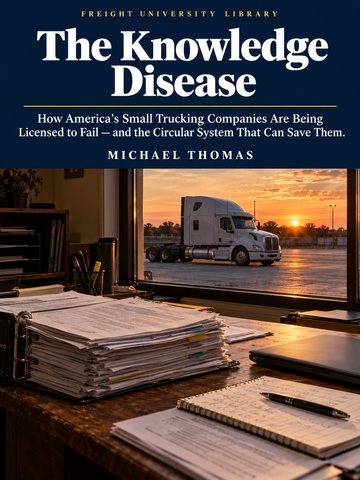 The Knowledge DiseaseWhy so many small carriers are licensed into trouble.
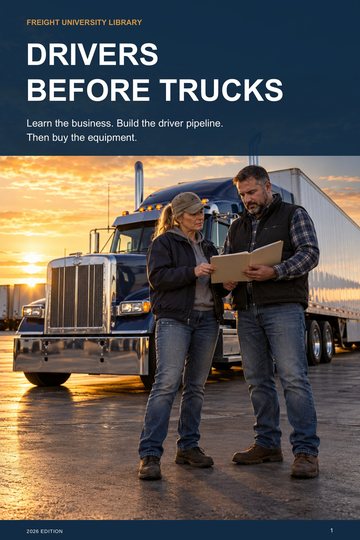 Drivers Before TrucksLearn the recruiting before you buy the equipment.
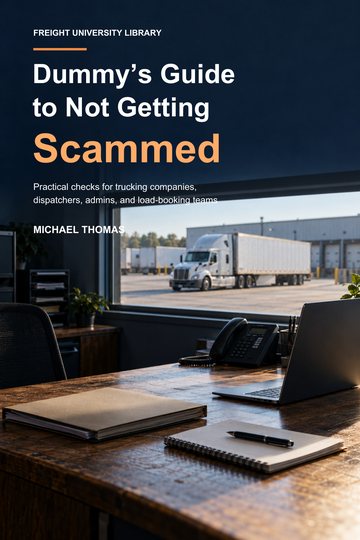 Dummy's Guide to Not Getting ScammedThe company in the signature may be real. Is the person?
Questions people ask
Why do most small trucking companies fail?
The ones I've watched close usually didn't run out of freight. They ran out of time and cash because of things they didn't see coming: a repair, an insurance renewal, a truck sitting, a bad load or a bad hire. Most of that is knowledge you can get before it costs you.
Can training actually keep a carrier open?
Training can't haul a load or pay a bill. What it can do is put the problem in front of you early, while you still have choices. That's what our courses are built around.
Who is this for?
New owners, owner-operators thinking about their own authority, and anyone who wants to be the back office that keeps small carriers running.
Is there a book on this?
Yes. The Knowledge Disease is the fully sourced version of this page. It's free in our library.
Build it with help
Rather not learn it one bad load at a time?
The Logistical Developmental Program at Logistical Forwarding Solutions (LFS) is one-on-one consulting for people setting up a trucking company, a freight brokerage or a logistics business. You work through the setup, the freight, the equipment, the drivers and the back office before the big money gets spent.
Start with Lesson 1 today.
Join with your name and email, set a password, choose a course and start. It's free.
Keep going
- What it costs to start a trucking companyGuide
- How to build a trucking companyGuide
- How to build a full-circle logistics businessGuide
- PLSPThe free PLSP course